info@gdaddtech.cn
+86-18566873215



A Glass Beveling Machine is built to turn a raw flat edge into a clean angled edge that looks brighter, smoother, and more valuable in the finished product. In practical factory work, this matters most for mirrors, decorative glass, shower panels, furniture glass, and architectural pieces where edge quality directly affects appearance and resale value. ADDTECH positions its equipment around this type of precision processing, with product coverage that includes beveling, edging, drilling, washing, laminating, and complete line solutions, which is useful for buyers who want process consistency across multiple stations rather than isolated machines.
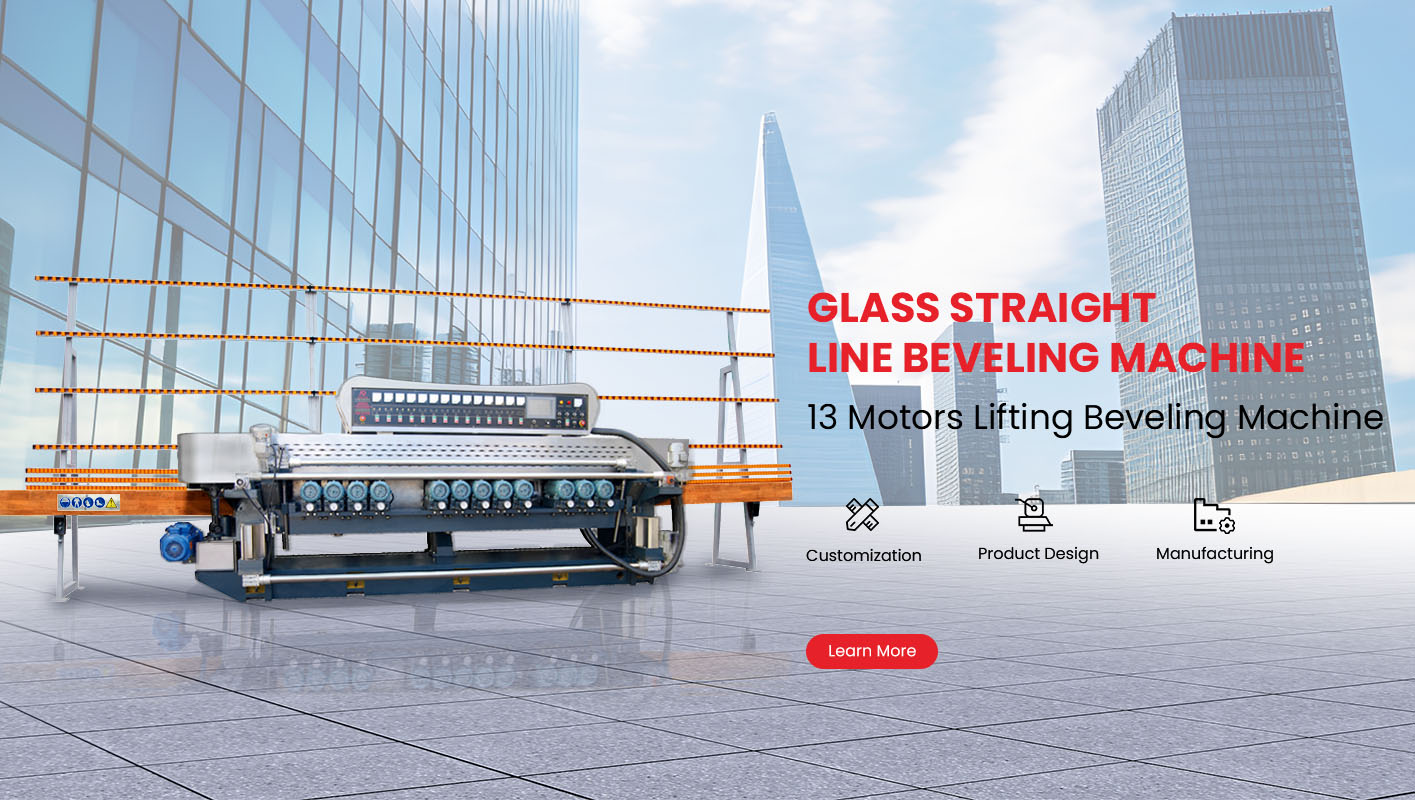
The machine works by moving glass along a controlled path while a series of grinding and polishing wheels remove material from the edge at a set angle. Instead of cutting the edge in one aggressive pass, the machine shapes it gradually. That staged process helps control chipping, heat, surface marks, and dimensional deviation. ADDTECH describes its beveling machines as equipment for grinding and polishing glass and mirror bevel edges, with bottom edge grinding integrated into the process.
In simple terms, the process starts when the operator sets the glass thickness, bevel angle, feed speed, and target width. The glass is then clamped and transported by the machine. As it moves forward, the first wheels perform rough grinding to remove excess material and create the general angle. The middle wheels refine the profile, and the final wheels polish the surface until the edge becomes clear and smooth. This is the core of bevel glass processing, where shaping and finishing must stay stable from sheet to sheet.
Before grinding starts, the machine must hold the glass securely and move it at a steady rate. Stable transport is critical because uneven feeding causes waviness, edge burn, polish inconsistency, and corner damage. ADDTECH specifications published for a recent beveling model show a feed speed range of 0.5 to 9 meters per minute, which shows how processing speed can be adjusted to match glass thickness and finish requirements.
The first grinding heads remove material quickly and form the main bevel profile. This stage is about shaping, not final appearance. If rough grinding is unstable, later polishing heads cannot fully correct the defect. For factories handling volume orders, this is where machine rigidity and drive stability make a visible difference in daily output quality.
After the edge profile is established, finer abrasive wheels improve flatness and reduce visible grinding marks. This stage prepares the surface for polishing and helps create a more uniform glass bevel edge across different production batches. When buyers compare finished glass from different suppliers, this consistency is often one of the first details they notice.
The polishing heads bring transparency and gloss back to the processed edge. A good polish should look bright and even, without cloudy zones or scratch patterns. On decorative glass products, polishing quality is often what separates an acceptable part from a premium one. That is why multi-head configurations remain important in modern glass fabrication equipment.
Many beveling jobs also require bottom edge grinding so the entire edge profile feels complete and balanced. This is especially useful for mirror and furniture glass applications where the side profile remains visible after installation. ADDTECH specifically notes bottom edge grinding as part of its beveling machine function.
The finished bevel depends on several production variables working together, not just on the number of wheels.
| Factor | Why It Matters |
|---|---|
| Glass thickness | Thicker glass usually needs more stable transport and adjusted speed |
| Bevel angle | Determines the visual profile and reflected light effect |
| Bevel width | Affects decorative impact and material removal volume |
| Feed speed | Influences edge quality, output rate, and risk of chipping |
| Wheel condition | Directly affects finish clarity and dimensional repeatability |
ADDTECH states that one of its beveling machines can process bevel angles from 3 to 45 degrees, bevel width up to 60 millimeters, glass thickness from 3 to 19 millimeters, and installed power of 27 kilowatts. Those figures show that a beveling machine is not just a finishing accessory. It is a controlled shaping unit with defined process limits.
Manual bevel finishing can still work for certain custom jobs, but it depends heavily on operator skill and consistency. In contrast, an automatic glass beveling system gives factories better repeatability, more predictable output, and less dependence on individual technique. That matters when lead times are tight, part dimensions must match from batch to batch, and finished glass must move into downstream washing, laminating, insulating, or assembly operations without rework. ADDTECH also presents broader process-chain capability across edging, drilling, washing, laminating, and line integration, which supports smoother plant planning when customers expand toward a full bevel glass production line.
For procurement teams, this brings several practical benefits. Training is easier when machine logic is consistent. Spare parts planning becomes simpler when equipment comes from one technical platform. Installation and after-sales communication also tend to be more efficient when one supplier understands the full workflow rather than only one isolated machine type. ADDTECH’s published product range reflects that broader manufacturing approach.
A machine may look suitable on paper, but the real question is whether it matches your product mix. Buyers should compare the working thickness range, bevel angle range, maximum bevel width, feed speed range, control method, lubrication design, and the ability to maintain polish quality over long shifts. ADDTECH product information highlights PLC and interface control, automatic and manual operation options, and automatic refueling on certain drive sections, which are all relevant to maintenance planning and operator convenience.
It is also worth checking whether the supplier can support future layout growth. Many glass plants do not stop at one machine. They later add edging, washing, drilling, lamination, or line connection. A manufacturer with a wider machinery portfolio can often support that expansion more effectively, both technically and commercially.
A glass beveling machine works by combining controlled transport, staged grinding, precision angle formation, and final polishing to produce a decorative and functional beveled edge. The quality of the result depends on machine stability, wheel configuration, parameter control, and how well the machine fits the real production mix. For factories that need cleaner output, lower rework, and more consistent edge quality, a manufacturer with complete process knowledge can offer more than a single machine sale. ADDTECH’s range in beveling and related glass processing systems makes that discussion more practical for buyers who are planning not only today’s order flow but also future production expansion.
Previous: