info@gdaddtech.cn
+86-18566873215



In glass processing, bevelling and standard edge grinding are often mentioned together, but they solve different production tasks. Standard edge grinding mainly removes sharpness, chips, and edge defects so the sheet can move safely into the next stage. Bevelling, by contrast, creates an intentional angled edge that changes both the look and the function of the glass. This distinction matters because modern building glass standards pay close attention to edgework, flatness, and mechanical performance, especially when glass will later be tempered or used with exposed edges. EN 12150 specifically covers edgework as part of the quality framework for thermally toughened safety glass, and industry guidance tied to ASTM C1048 notes that exposed-edge heat-treated glass should be polished before heat treatment.
A standard grinding line is usually selected when the main target is safe handling, size accuracy, and edge consistency. It is the practical choice for architectural panels, insulated glass components, shower panels, furniture parts, and mass-production lines where appearance at the edge is important but not decorative. The process typically focuses on arrising, seaming, or polishing the straight edge so downstream washing, tempering, laminating, and assembly can proceed with lower breakage risk and better repeatability. Industry guidance from the National Glass Association notes that edge condition can affect the long-term structural performance of finished glass products, which is why edge preparation is more than a cosmetic step.
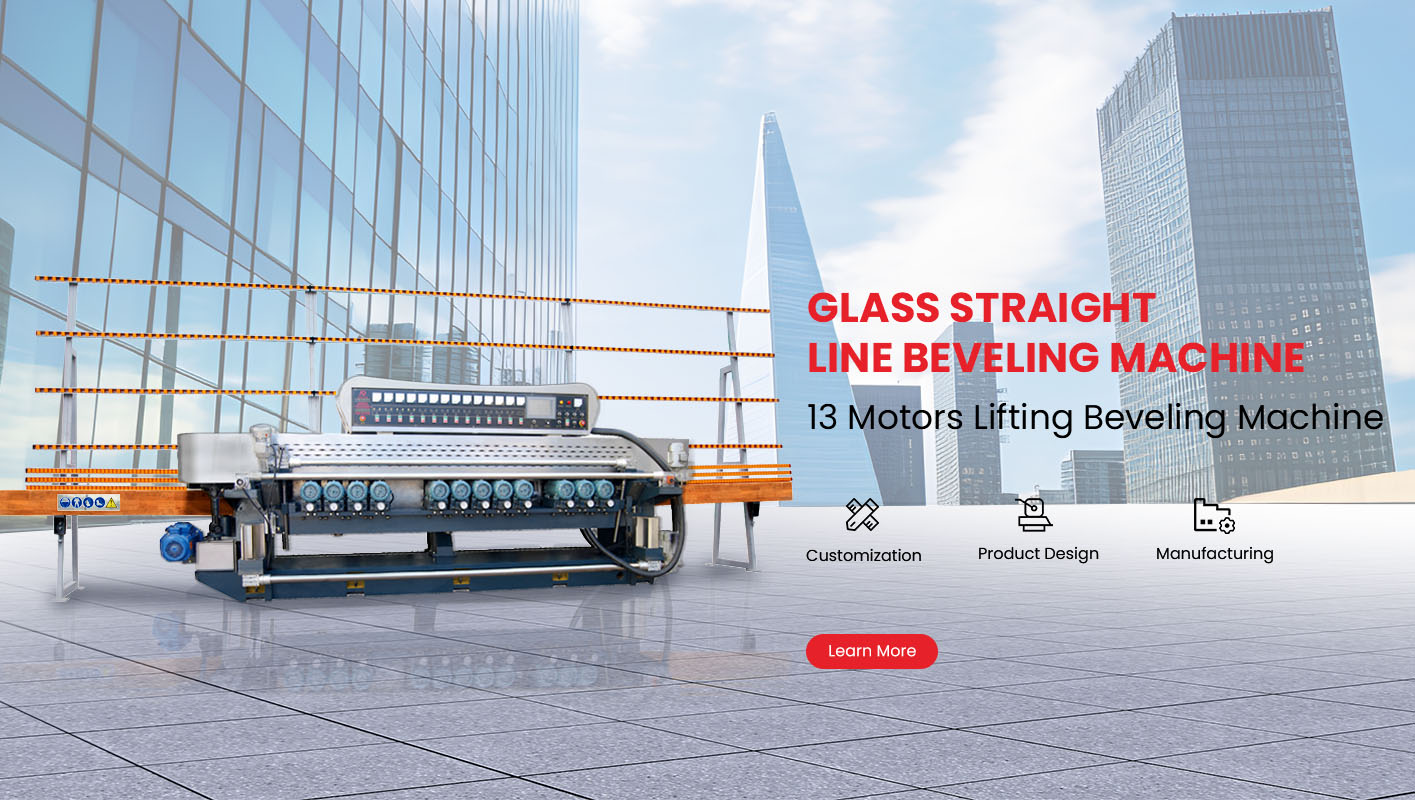
A bevelling line has a different purpose. It removes material at an angle across the perimeter, producing a sloped face that catches light and creates a refined visual border. In practical terms, that makes bevelled glass more suitable for mirrors, decorative wall panels, furniture inserts, cabinet glass, and interior applications where edge presentation is part of the final value. A glass edge beveling machine is therefore not simply a stronger grinder. It is a dedicated solution for shaping the edge profile itself, often with bottom-edge grinding and polishing integrated into one coordinated process. ADDTECH describes its straight-line beveling machine as equipment designed for grinding and polishing bevel edges on glass and mirrors with bottom-edge grinding, which reflects this more specialized role.
| Item | Standard edge grinding | Bevelling machine |
|---|---|---|
| Main goal | Remove sharpness, chips, and edge defects | Create an angled decorative edge |
| Edge profile | Flat or lightly arrised finished edge | Sloped bevel plus finished bottom edge |
| Typical value | Safety, handling, further processing stability | Visual depth, premium finish, higher decorative value |
| Common downstream use | Tempering, laminating, insulating, framing | Mirrors, furniture glass, decorative architectural glass |
| Process focus | Dimensional accuracy and edge integrity | Angle control, bevel width, polish quality |
The table shows why the two machines are rarely interchangeable in high-standard production planning. One protects process flow and structural consistency, while the other adds a defined optical effect and a more premium finished appearance.
When production lines prioritize throughput and low breakage during later steps, standard edge grinding often delivers the best balance. This is especially true for glass that will be tempered, because exposed-edge heat-treated products demand better edge finish control. The National Glass Association presentation on edge grinding states that, according to ASTM C1048, exposed-edge glass that will be heat-treated should be polished before heat treatment. That requirement alone can shift the decision toward a more refined grinding setup even when a decorative bevel is not needed. (Glass)
When the project requires decorative value, beveling becomes the better fit because the edge itself becomes part of the design language. Beveling creates a wider visible processing zone than standard grinding, so the machine must control angle, width, feed stability, and polishing quality together. ADDTECH’s ADXM371B glass edge beveling machine is specified for bevel angles from 3 degrees to 45 degrees, maximum bevel width up to 60 mm, glass thickness from 3 mm to 19 mm, and feeding speed from 0.5 m per minute to 9 m per minute, with 27 kW installed power. These numbers show that beveling is a controlled shaping process, not just a finishing pass.
Standard edge grinding usually carries a simpler cost structure because it removes less material and asks for less optical refinement. Tooling strategy, maintenance, and operator setup are generally more straightforward when the final edge is flat or lightly polished. Bevelling adds more variables, including angle setting, bevel width, and polishing consistency across the full edge. That often means more setup time, more attention to wheel condition, and higher expectations for visual inspection at the exit end. For buyers planning repeated decorative production, the real question is not just machine price, but whether the equipment can hold the same bevel geometry over long runs with acceptable maintenance intervals.
This is where machine design details matter. ADDTECH states that its equipment is built around high-precision glass processing, with independent production workshops, product development teams, strict quality inspection, and CE certification. On the beveling model page, the company also highlights PLC control, automatic and manual operating modes, variable frequency speed adjustment, automatic refueling for front and rear platen drive, and stainless steel construction for the electric box, shield, and water tank. Those details matter because beveling quality depends heavily on stable mechanics and repeatable control.
For framed glass, insulated units, and many standard architectural panels, conventional edge grinding is often the most efficient answer because the edge may not remain visually dominant after installation. For exposed-edge interior glass, decorative mirrors, furniture tops, and premium display applications, beveling often creates stronger commercial value because it turns the perimeter into a visible design feature. In other words, standard grinding prepares glass for performance and processing, while beveling prepares glass for presentation as well as finishing. The right choice depends on whether the edge will be hidden, exposed, structural, decorative, or all four at once.
A bevel must stay consistent from corner to corner, otherwise light reflection changes and the finished sheet looks uneven. That is why a glass edge beveling machine needs strong transmission stability, reliable beam adjustment, controlled feed speed, and accurate polishing action. ADDTECH’s beveling equipment uses a bearing transmission system and adjustable front beam, and the company positions its machines as stable and easy to maintain. For factories that must balance appearance, uptime, and service life, those features help reduce the gap between sample quality and mass-production quality.
ADDTECH was founded in 2007 in Foshan and focuses on high-precision glass processing equipment across edging, beveling, washing, drilling, shaping, and laminating categories. The company describes itself as a national high-tech enterprise with CE certification and emphasizes machining accuracy, strict inspection, customized solutions, and after-sales support. For buyers comparing bevelling machines with standard edge grinding solutions, this wider product coverage is useful because it supports a more complete process discussion rather than a single-machine sale. That is especially valuable when beveling must match upstream cutting quality and downstream washing or tempering requirements.
The difference between bevelling machines and standard edge grinding is not merely the shape of the finished edge. It is a difference in production objective. Standard grinding is mainly about safety, dimensional reliability, and process readiness. Bevelling is about controlled edge geometry, optical quality, and added product value. When the glass edge must become part of the finished appearance, a dedicated glass edge beveling machine offers capabilities that standard edge grinding cannot fully replace. When throughput, safety, and downstream stability are the priority, standard edge grinding remains the more direct solution. The best equipment decision comes from matching edge function, visual requirement, thickness range, and line productivity to the actual product mix, and that is exactly where a specialized manufacturer such as ADDTECH brings practical value.
Previous: