info@gdaddtech.cn
+86-18566873215



Manual bevel finishing can produce beautiful results, but it depends heavily on operator skill, stable hand pressure, and consistent abrasive management. As glass fabrication orders move toward tighter tolerances and faster delivery, many plants are asking whether automated beveling can truly replace manual work, or only reduce it.
Industry demand is moving in the direction of scale and repeatability. Grand View Research estimates the global flat glass market at USD 311.44 billion in 2024 and projects USD 404.76 billion by 2030, driven by construction and solar demand growth that pressures processing capacity and consistency.
In real production, replacement usually means meeting three targets at the same time:
Edge geometry is consistent across operators and shifts
Surface finish is repeatable with controlled wheel sequence and feed rate
Defect risk is controlled including chips, burns, waviness, and edge roll
For building glass and safety applications, edge finishing requirements are commonly tied to standards and customer specifications. ISO 12543-5 is one reference for laminated glass dimensions and edge finishing expectations in building use.
Manual finishing can drift as wheels wear, coolant concentration changes, or operators vary pressure. Automated platforms lock in feed speed, glass positioning, wheel engagement, and polishing sequence. This is why automated processes are increasingly common in modern fabrication plants, alongside CNC and automated lines.
Bevel finishing creates fine dust and slurry, especially when dry handling or poor extraction occurs. For facilities exporting to the United States, OSHA sets a permissible exposure limit for respirable crystalline silica of 50 micrograms per cubic meter as an 8 hour time weighted average, which pushes factories toward better dust control, wet processing, and enclosure design.
Grinding and polishing automation is commonly justified through labor reallocation, reduced rework, and lower variability. PushCorp notes many manufacturers aim for payback in the 18 to 24 month range for robotic grinding projects, depending on cycle time and utilization.
Automated equipment does not eliminate craftsmanship in every scenario. Manual bevel work can remain valuable for:
Very small batches or frequent profile changes where setup time dominates
Irregular shapes that fall outside the stable clamping and tracking range
Prototype or sample work before wheel packs and parameters are finalized
Edge repair and touch-up when incoming cut quality is unstable
The practical goal for most factories is not a full ban on manual finishing, but a production model where manual steps become exception handling rather than daily throughput.
| Decision factor | Manual bevel finishing fits better | Automated beveling fits better |
|---|---|---|
| Daily volume | Low or highly variable | Medium to high and repeatable |
| Quality target | Visual grade acceptable | Tight geometry and uniform gloss |
| Labor availability | Skilled operators stable | Operator turnover or scaling needed |
| Defect cost | Rework is affordable | Scrap or rework is expensive |
| Export compliance | Basic internal control | Stronger process control documentation |
ADDTECH is focused on high precision glass processing equipment with stability and maintainability as core design priorities. The company states it was founded in 2007, holds EU CE certification, is recognized as a national high-tech company, and has more than ten invention patents in China, with exports to over 60 countries and regions.
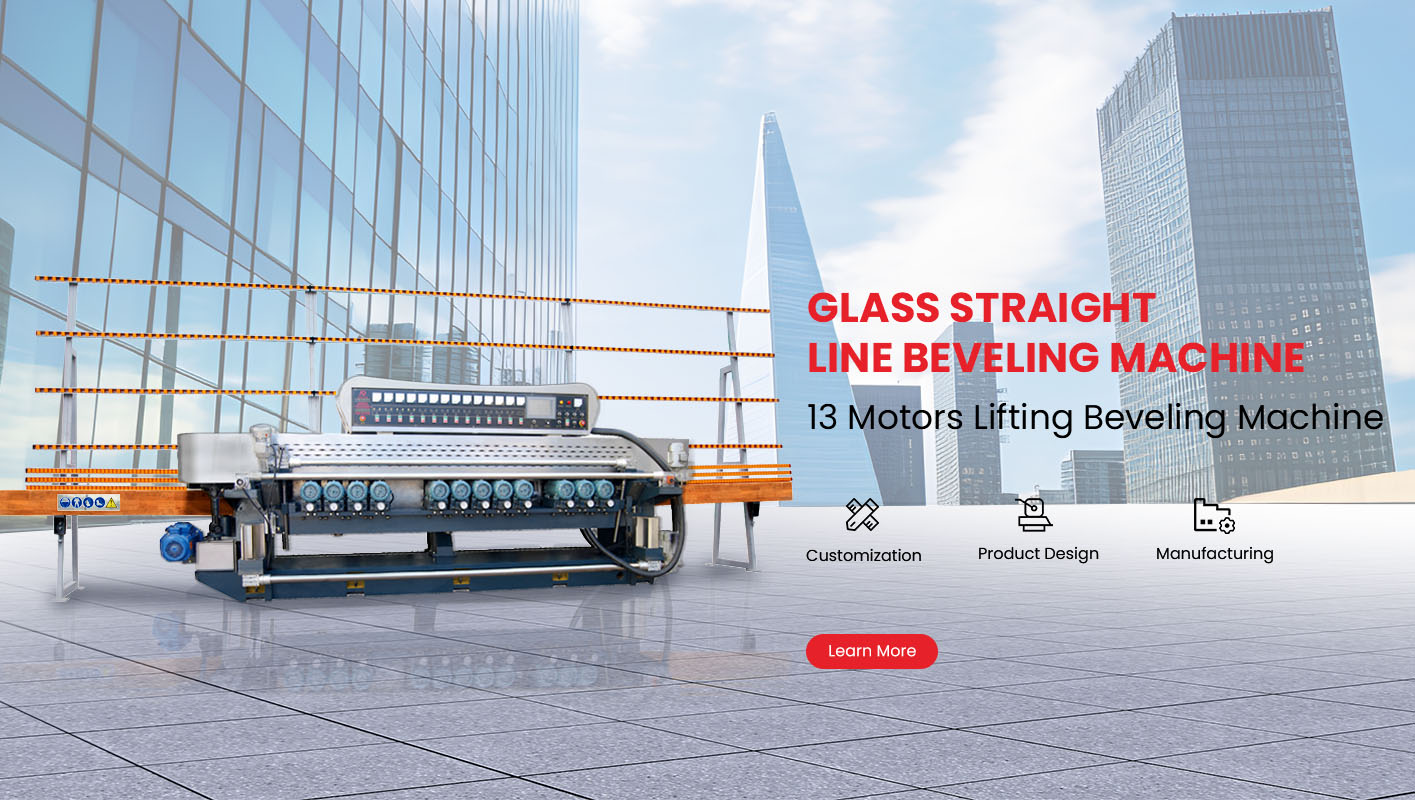
In practical projects, replacement success depends on matching the machine configuration to your edge target and glass mix. For a straight line Glass Beveling Machine for mirror edging, the most important factors are wheel sequence design, spindle rigidity, coolant management, and stable conveying. For an automatic glass beveling machine for laminated glass, the key is consistent pressure control and edge protection to reduce micro chipping before polishing.
9 Motors Glass Beveling Equipment is typically selected when a factory needs stronger stage separation across rough grinding, fine grinding, and polishing so the bevel geometry stays stable while the gloss rises. More stages allow each wheel to run in its optimal material removal range, helping reduce manual blending between steps and improving batch consistency for bulk order schedules.
To support quoting and line selection, define these inputs before procurement:
Glass thickness range and maximum size
Required bevel width range and target gloss level
Expected daily meters or pieces by shift
Incoming cut edge quality and chip tolerance
Packaging standard and downstream washing needs
Automated beveling can replace most manual bevel finishing when the job is repeatable, the quality target is defined, and the equipment is configured for your glass mix and defect tolerance. Manual work still matters for exceptions, prototypes, and irregular pieces, but it should no longer be the bottleneck for stable output.
Share your glass specification, bevel target, and daily capacity plan with ADDTECH, and the team can recommend the right Glass Beveling Machine layout, wheel stage strategy, and process checkpoints for commercial-grade consistency and wholesale production rhythm.