info@gdaddtech.cn
+86-18566873215



Glass is no longer a simple sheet material. In buildings, transportation, and interior projects, it is specified for safety performance, edge finish, optical clarity, and coating protection. That shift is one reason the flat glass market is measured in the hundreds of billions of dollars, with continued growth projected through 2030.
From a manufacturing viewpoint, the right glass processing machinery lineup is not a long list of machines, but a matched process chain that controls yield, consistency, and downstream installation risk.
Most factories follow a similar sequence, even when products differ.
Cutting and breakout to size and shape, with stable edge allowance for later finishing
Edge grinding and polishing to remove micro cracks and improve handling safety
Drilling and milling for hardware, hinges, cutouts, and mounting patterns
Washing and drying to remove grinding residue before coating, laminating, or assembly
Laminating or surface protection steps when the design requires safety interlayers or film
Final inspection focused on edge quality, hole accuracy, and surface cleanliness
When this chain is designed well, it supports repeatable output across architectural glazing, shower enclosures, mirrors, partitions, furniture glass, and fabrication components.
Below is a practical map of major equipment categories, typical applications, and what to check during selection.
| Machinery type | Main function | Typical applications | Key checks during selection |
|---|---|---|---|
| Glass Edging Machine and glass edging machine line | Rough grind, fine grind, chamfer, polish in one pass | Doors, windows, partitions, shelves, furniture panels | Edge gloss stability, thickness range handling, motor configuration, setup repeatability |
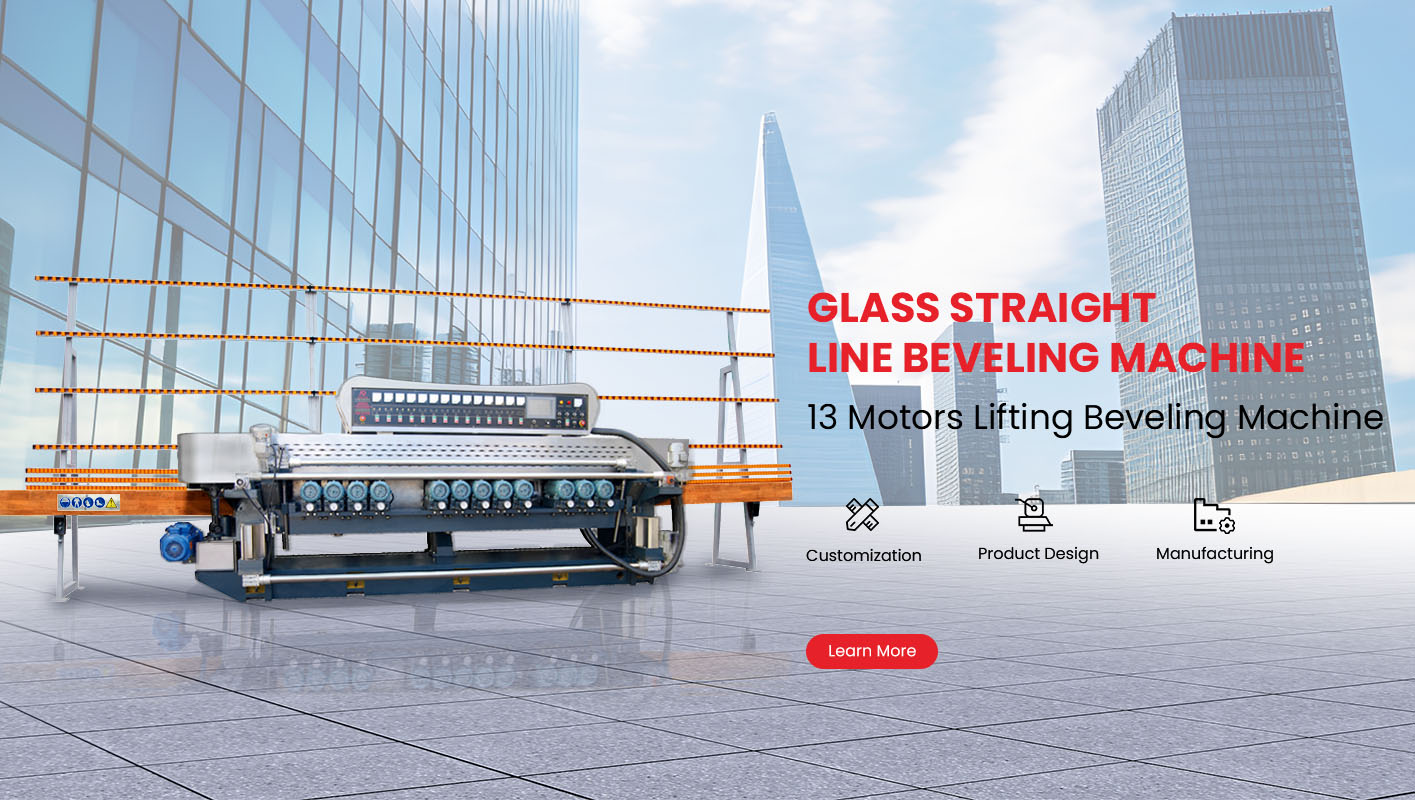
| Glass Beveling Machine and Glass Pencil Edging Machine | Decorative and functional edge profiles | Mirrors, furniture edges, interior glass | Profile consistency, burn marks control, polishing quality on corners |
| Glass 45 Degree Edging Machine and angle processing | Controlled angle edges for special geometry | Rhombic panels, design glass, large panels with angled edges | Angle accuracy, safe handling for large sizes, PLC stability |
| Glass drilling machine | Holes for hinges, handles, standoffs, mounting | Shower enclosures, balustrades, hardware glass | Hole position repeatability, breakout control, multi diameter capability |
| Irregular glass grinding machine | Edge finishing on shaped glass | Special shaped panels, decorative glass | Template tracking stability, edge uniformity on curves |
| Glass washing machine | Cleaning and drying before assembly or further steps | Tempering prep, insulating glass prep, laminating prep | Brush material suitability, water contact materials, drying performance |
| Glass double laminating machine | Film laminating for coated or insulating glass surfaces | Low E related handling, insulating glass related handling, surface protection | Film alignment control, repeatable adhesion, handling speed |
| Glass breaking machine | Controlled breakup for recycling or process needs | Waste glass recovery, material processing | Particle size control, safety guarding, throughput stability |
The equipment categories above align with common product families published by ADDTECH, including straight line edging, beveling, washing, drilling, irregular grinding, and double sided film laminating equipment.
Edge quality is not only visual. A stable edge reduces chipping during transport, improves handling safety, and reduces spontaneous break risk during installation. For glass processing machinery for architectural glazing, edge consistency is often a first pass filter during incoming inspection by project teams.
For glass processing machinery for shower enclosure fabrication, hole position and breakout control directly affect hardware fit and field installation time. Double head drilling configurations also support mixed hole sizes on one panel, improving takt time for high mix orders.
After grinding and drilling, fine particles and slurry residue can cause visible defects, coating damage, or poor adhesion in later steps. Vertical and horizontal washing lines are commonly used before insulating glass assembly, film processes, or tempering preparation, and are often specified for Low E related cleaning needs.
Laminating related equipment supports safety and surface performance where design specs require layered structures or protection films. ISO 12543 defines key terminology and component parts for laminated glass in building applications, making process control and documentation essential for consistent output.
Even when the final product spec is defined by the customer, most audits focus on a few measurable checkpoints.
Edge chipping rate after edging and after washing, tied to handling and packing method
Hole edge breakout and position tolerance, tied to jig control and spindle stability
Surface cleanliness after washing, tied to brush condition, water quality, and drying knife performance
Traceable process documentation for safety glass related projects, where standards and internal QC records must match declared performance
For tempered safety glass, fragmentation testing is commonly referenced in EN 12150, and fragment counting is used as an indicator of stress state and safety behavior.
ADDTECH focuses on high precision glass processing equipment and positions its core value around stability and maintenance practicality. The company states it was founded in 2007 in Shunde, Foshan, and holds national high tech company positioning and EU CE certification.
From the product side, ADDTECH publishes a complete range that covers edging, beveling, pencil edging, drilling, irregular grinding, washing, and film laminating, which helps factories build a coherent process chain with one engineering logic across stations.
For customers sourcing glass processing machinery for bulk production, that consistency reduces integration time, training burden, and spare parts complexity.
The key types of glass processing machinery are best understood as a connected system: cutting and breakout define geometry, edging defines durability and safety, drilling defines assembly accuracy, washing protects downstream quality, and laminating or film steps protect performance requirements. With the right lineup and QC checkpoints, factories can raise yield, shorten changeovers, and deliver predictable finishes across high mix project orders.