info@gdaddtech.cn
+86-18566873215



In the field of glass and stone processing, edge finishing plays a decisive role in determining both the appearance and safety of the final product. Two of the most commonly used machines in this process are the straight-line edging machine and the beveling machine. Though both serve to refine and shape edges, their functions, structure, and application scope differ significantly. Understanding these differences helps manufacturers and buyers choose the right machine for their production lines.
A straight-line edging machine is primarily designed to process the flat edges of glass, marble, or quartz materials in a linear direction. It removes roughness, chips, and irregularities from the edge to create a smooth, accurate, and polished surface.
Modern straight-line edging machines use multiple grinding wheels—typically diamond or resin—to perform rough grinding, fine grinding, and polishing in one continuous process. The conveyor system ensures consistent feed speed and stable pressure, resulting in uniform edge quality.
These machines are particularly valued for their precision and efficiency in mass production. They are widely used in the manufacture of glass doors, furniture panels, and architectural glazing systems where straight and flat edges are required.
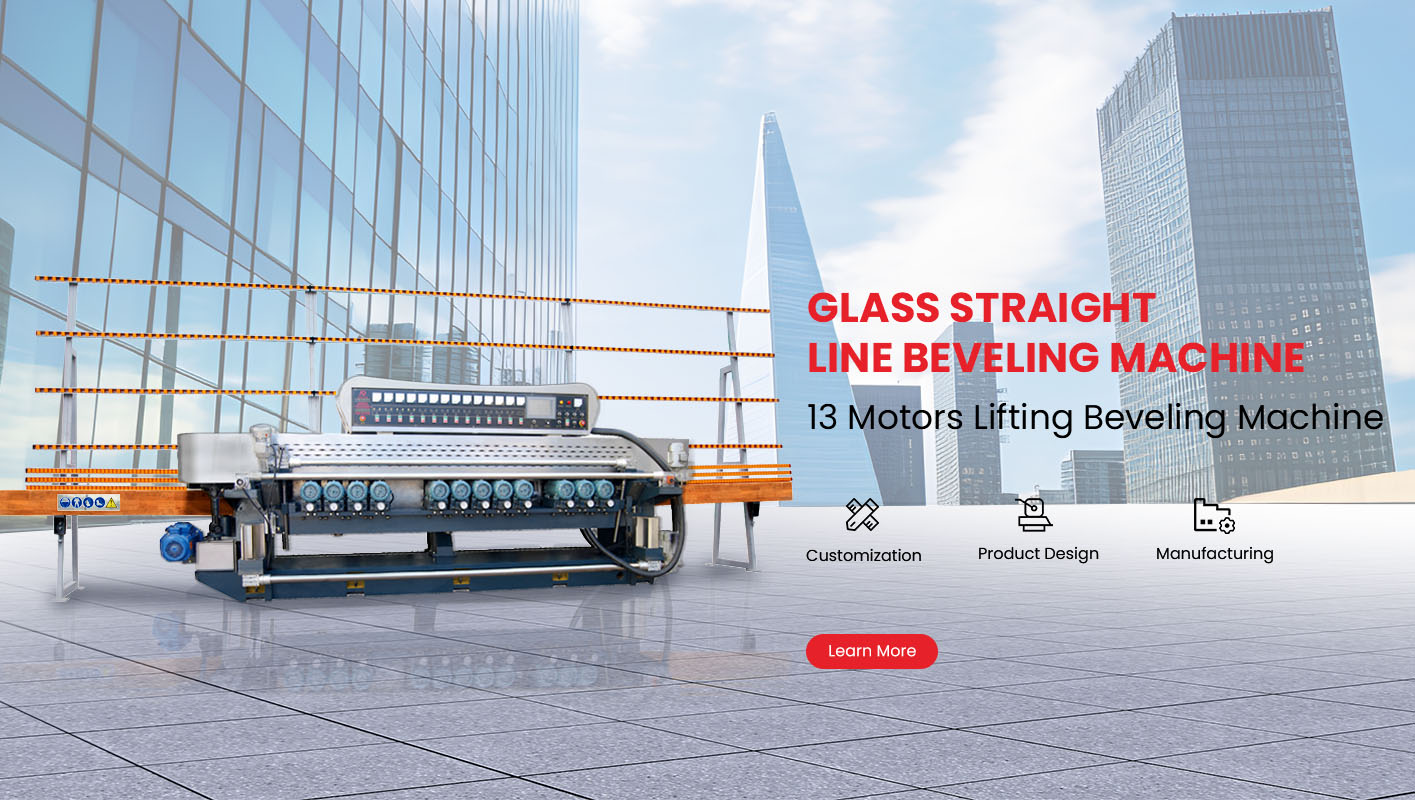
A beveling machine is used to create angled or decorative edges rather than flat vertical ones. It grinds the edge of glass or stone at a specific angle—commonly between 3° and 45°—to produce a chamfered or beveled edge. This process not only enhances visual appeal but also improves safety by removing sharp corners.
Beveling machines often integrate multiple grinding wheels of varying grain sizes to carry out rough beveling, fine beveling, and polishing in stages. Some advanced models allow programmable angles and automatic adjustment to accommodate different thicknesses of materials.
In decorative architecture, furniture glass, and mirror production, beveling adds a sense of dimension, light refraction, and elegance, transforming ordinary glass into a high-value design element.
| Aspect | Straight-Line Edging Machine | Beveling Machine |
|---|---|---|
| Purpose | Creates flat, polished edges along straight lines | Produces angled or decorative beveled edges |
| Edge Type | Vertical or 90° edges | Angled edges from 3° to 45° |
| Typical Use | Doors, windows, partitions, flat glass panels | Mirrors, furniture glass, decorative panels |
| Processing Method | Linear edge grinding and polishing | Angled edge grinding and polishing |
| Precision Requirement | High geometric precision and uniform thickness | High angle accuracy and surface reflection quality |
| Aesthetic Impact | Emphasizes clarity and structural alignment | Emphasizes visual depth and luxury appearance |
| Machine Configuration | Usually 8–11 spindles | Usually 9–15 spindles with angular adjustment |
| Operation Speed | Faster, suitable for mass production | Slightly slower due to complex angles |
While both types contribute to edge finishing, the straight-line edging machine focuses on functionality and uniformity, whereas the beveling machine emphasizes aesthetics and customization. Many glass processing workshops operate both types to serve different project demands.
The choice between these two machines depends on your application and design goals.
For architectural and industrial projects Straight-line edging machines are ideal for producing glass panels used in doors, curtain walls, or partitions. They ensure exact dimensions and perfect flatness.
For decorative or high-end interior applications Beveling machines are better suited for mirrors, furniture glass, or luxury interiors where visual impact is crucial.
For multi-purpose workshops Combining both machines offers flexibility—using straight-line edging for functional glass and beveling for artistic finishing. This hybrid setup improves production diversity and market competitiveness.
When investing in glass or stone edge processing equipment, ADDTECH provides a reliable and innovative solution. The company specializes in precision machinery, offering models that integrate intelligent control systems, stable servo drive technology, and high-efficiency grinding components.
ADDTECH’s straight-line edging and beveling machines are engineered for:
Consistent edge accuracy even under high-speed operation
Energy-efficient performance with optimized motor systems
User-friendly operation through intuitive interfaces and digital settings
Durability and low maintenance supported by robust mechanical design
With its deep technical expertise and commitment to quality, ADDTECH ensures every product delivers stable performance and long service life, meeting the exacting demands of global manufacturers.
In essence, both straight-line edging and beveling machines play indispensable roles in the glass finishing industry. The former ensures dimensional precision and productivity, while the latter elevates the visual and decorative qualities of the final product. Understanding their differences allows manufacturers to optimize their production setup and achieve the desired balance between functionality and aesthetics.
For businesses seeking dependable and advanced edge processing equipment, ADDTECH remains a trusted partner providing cutting-edge technology and reliable after-sales support to help you achieve superior results in every production run.